Saturday 21st January 2017
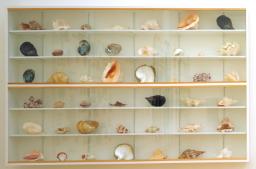
Damien Hirst’s ‘Forms without Life’
10 years ago art dealer David Zwirner complained about the “lack of excitement in New York”. Although there is no shortage of money in the Contemporary art market which constantly makes the headlines right now, it’s not really the problem. The fact is, Contemporary art is ruled by a doctrine of novelty that’s decades old, and looking increasingly out of date.
Art dealers, curators and critics still cling to the idea that what constitutes today’s art with a capital “A” must be totally new and groundbreaking. Sadly, more than 60 years after the true game-changer of Abstract Expressionism (if only to use the U.S. as an example), the art world is still at it. Yet anyone remotely connected to Contemporary art with a shred of honesty would admit that the novelty idea went bankrupt some time ago.
This is how we know precisely that we’re not in any Golden Age for visual art: There’s the spectacle of obsessive, trigger like bidding on lonely, singular canvasses by the few, but no broadly shared delight and conversation, excess of excellence or intellectual credibility.
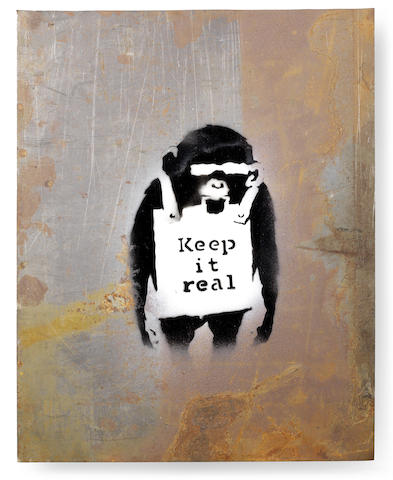
Banksy’s ‘Keep it Real’ 2006 (sold at Bonhams for £194, 500)
The price paid for insistence on novelty is not only alienation of the general public but an artificial restriction of the very definition of Contemporary art.
Today, in order for ‘Art’ to earn its way into the museum or gallery, the artwork must take a radical new form, but once it’s been hanging on the wall for a while, it’s not as if curators give an honest assessment of why it’s there: “Well, it was a novelty at the time”.
As ‘Society’ evolves and not necessarily for the better, what is the future for ‘Contemporary Art’?
Wishing you a prosperous and happy year ahead.
Best Wishes
Claire
Claire Moore BA(Hons), GALLERY MANAGER
 A FIRST SIGHT OF ‘TURNING TO STONE’